Tropico 6 Plantations: Build an Agricultural Economy with Efficient Layouts
The plantation is one of the basic buildings for an agricultural economy in Tropico 6. They provide raw materials for several profitable industries, including rum, cigars, chocolate, and apparel. This guide explains how to choose between traditional and Hydroponic Plantations, organise crops into efficient farming blocks, and build an economy around agricultural production. It also covers which processed goods are worth prioritising and whether a plantation-based economy can support the entire island.
Table of Contents
- Traditional vs. Hydroponic Plantations in Tropico 6
- Which Crops Are the Most Profitable?
- Tropico 6 Plantations Layout: Build Multiculture Blocks
- Hydroponic Plantation Layout: A Simpler Alternative
- Worker Commute: An Important Part of Plantation Efficiency
- Can a Plantation Economy Support the Entire Island?
Traditional vs. Hydroponic Plantations in Tropico 6
Tropico 6 offers two types of plantations, each suited to a different stage of economic development.
- Traditional Plantations are available from the Colonial Era. They do not require electricity, making them relatively cheap to operate. However, their efficiency depends on local soil fertility. Monoculture gradually degrades the soil, reducing production over time unless the player moves the plantations from place to place to manage fertility carefully.
- Hydroponic Plantations become available in Modern Times. They require electricity and high-school-educated workers, but their production is independent of local soil conditions. They also take up much less space and feature a higher production rate.
Both types can grow the same crops and share the same crop-specific upgrades. Hydroponic Plantations are therefore a convenient way to maintain reliable production without worrying about soil degradation. However, the player can still stick to the traditional plantations and make them work in the modern era. They can supply modern industries fully with proper arrangements as well.
Explore: Tropico 6 Tourism Guide: How to Attract Tourists, Increase Ratings, and Make Money
Which Crops Are the Most Profitable?
Before getting into more details about Tropico 6 plantations, it’d be best to get a general idea of the most profitable crops in the game. The best crops depend on the processing industries the player wants to develop. Instead of exporting every raw agricultural product, it is usually more profitable to turn selected crops into higher-value goods.
Three industries are particularly useful:
- Rum: Sugar is processed by Rum Distilleries. Rum is available from the Colonial Era, making it a strong early export industry.
- Cigars: Tobacco is processed by Cigar Factories. This is another valuable industry that can be established early and expanded as production increases.
- Apparel: Cotton is processed into cloth by Textile Mills. Fashion Companies then use cloth and leather to produce apparel. The leather supply must come from another source, such as cattle or crocodile ranches, or imports.
Chocolate, juice, and canned goods are also worth considering. They provide additional ways to process crops such as cocoa, sugar, bananas, pineapples, etc. However, if the goal is to build a focused plantation economy, rum, cigars, and apparel are good core industries to prioritise. On the other hand, the player usually needs to grow more crop types if going for the multiculture mode. In that case, side industries like chocolate, juice, and canned goods are great choices.
Explore: Tropico 6 Ranches: Types, Manure, and Efficient Farming Strategies
Tropico 6 Plantations Layout: Build Multiculture Blocks
Traditional plantations require more planning because monoculture gradually degrades the soil. Once fertility falls, production efficiency declines, and the processing factories that depend on the crops may run short of materials.
One solution is to move the plantations from place to place. Once the land is not used for a while, the fertility will recover to the default stats. The same logic works for the ranches as well. However, this can take up a lot of land, as the player needs to leave some patches of land to recover the fertility.
Another solution is to organise plantations into compact Multiculture blocks. The Multiculture work mode prevents soil degradation, but it starts with a 40% efficiency penalty. Nearby plantations growing different crops in the same work mode provide a 10% efficiency bonus per distinct crop type. With four to five different neighbouring crop types, the bonus can offset the initial penalty.
A practical block for the main export industries can include:
- Two Sugar Plantations: Sugar supports both Rum Distilleries and Chocolate Factories. The Fiber Fertilization upgrade also increases the efficiency of nearby plantations and Hydroponic Plantations by 10%, up to a 20% cap. Two sugar plantations can maximize this effect in the block.
- One Tobacco Plantation: Tobacco supplies Cigar Factories. Its Extensive Fertilization upgrade increases its own efficiency by 50%.
- One Cotton Plantation: Cotton supplies Textile Mills for the apparel industry. Because the cotton plantation does not have efficiency upgrades, it needs to rely on the buffs from the sugar plantation and multiculture work mode for an efficiency boost.
- One Cocoa Plantation: Cocoa supports Chocolate Factories. Its Inoculation upgrade increases its own efficiency by 30%.
- One Additional Crop: Add another crop type, such as coffee, bananas, or pineapples, to provide the fifth distinct crop in the block.
Keep the plantation farmhouses within the influence radius of one another; simply placing the fields close together is not enough.
Two blocks like this are more than enough to supply a set of one Rum Distillery, one Cigar Factory, one Textile Mill, one Fashion Company, and one Chocolate Factory. Based on this ratio, the player can expand the number of plantations and factories accordingly.

Explore: Tropico 6: How to Increase Liberty Happiness and Deal With Rebels
Hydroponic Plantation Layout: A Simpler Alternative
Hydroponic Plantations make agricultural planning considerably easier. Since they do not depend on local soil fertility, the player does not need to organise large multiculture blocks or constantly worry about monoculture degrading the land.
A straightforward approach is to pair each Hydroponic Plantation with the processing industry that consumes its crop. For example:
- One Tobacco Hydroponic Plantation beside a Cigar Factory.
- One Sugar Hydroponic Plantation beside a Rum Distillery.
- One Cotton Hydroponic Plantation beside a Textile Mill.
- One Cocoa Hydroponic Plantation beside a Chocolate Factory.
The production rate of a Hydroponic Plantation is usually slightly higher than its processing factory. The crop-specific upgrades still apply to Hydroponic Plantations.
The main limitation is electricity and high-school-educated workers, but meeting these conditions is relatively easier compared to arranging traditional plantations.

Explore: Cyberpunk 2077: How to Inspect Weapons on PC and Controllers
Worker Commute: An Important Part of Plantation Efficiency
Even a well-designed farming district can underperform if workers spend too much time travelling between home and work. Plantations need at least one worker present at the workplace to produce goods. Long commutes can therefore reduce the time buildings spend operating.
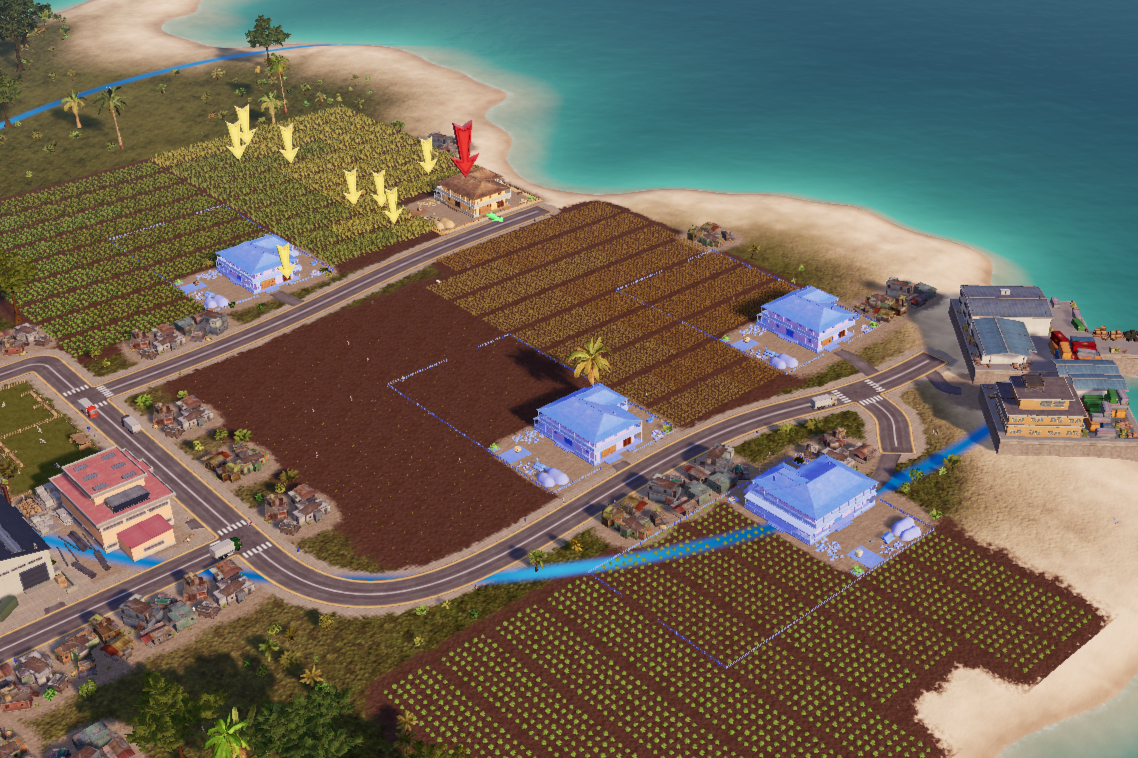
To check whether this is a problem, select a plantation and use the speed-up function. Watch the workers (indicated with yellow arrows) travelling between their homes and the farm. If they spend a long time walking across the island, consider improving the local transport and housing arrangements.
There are two straightforward solutions:
- Build houses near plantations: Providing nearby accommodation reduces the distance workers need to travel. This is particularly useful for agricultural districts outside the main city. The player can also check areas with shacks to determine where houses need to be built.
- Use Metro Stations: In later eras, metro connections can help workers travel between residential and industrial areas more quickly.

Explore: Nivalis Nights Party Haven Quest Guide: Earn 30,000 Lims
Can a Plantation Economy Support the Entire Island?
Yes. A plantation-based economy can support an entire island, without tourism, without tropicoin, and without mining.
Rum and cigars are suitable industries to establish early because their raw materials are available from the Colonial Era. As the island develops, cotton production can support Textile Mills and Fashion Companies, expanding the economy into apparel. The player can also add chocolate, juice, and canned goods to diversify exports.
The good thing about developing an agriculture-based economy is that the development arc from the colonial era to the modern era is smooth and uninterrupted. The player does not have to jump from the production of rum to weapons and cars. With the diversity of crops provided by the farming blocks, the player can build factory buildings directly as the blueprints get unlocked, since the raw materials are already provided.
🌴 Looking for help building your island, managing your economy, or keeping your citizens from revolting? Our Tropico 6 Guide Hub covers everything from beginner tips and city-building strategies to economy guides and much more. We add new guides regularly, so check back as you build your tropical paradise!

Tropico 6 Plantations: Build an Agricultural Economy with Efficient Layouts
Support thriving economies through efficient plantation layouts, processing industries, and workforce management….

Tropico 6 Tourism Guide: How to Attract Tourists, Increase Ratings, and Make Money
Tropico 6 tourism thrives through accessible arrivals, quality facilities, targeted entertainment, efficient layouts, and gradual investment in wealthier visitors….

Tropico 6 Ranches: Types, Manure, and Efficient Farming Strategies
Tropico 6 ranches support sustainable economies through strategic animal choices, manure management, upgrades, and efficient production chains….

Tropico 6: How to Increase Liberty Happiness and Deal With Rebels
Increase liberty happiness through these adjustments, or suppress the uprisings with your military power!…

Anno 1800 vs. Tropico 6: Which City-Building Strategy Game Should You Play?
Anno 1800 emphasizes complex production chains and logistics, while Tropico 6 prioritizes flexible economies and political management….

Tropico 6 Tips for Beginners: Money, Politics, and Island Management
Prioritize stable economies, faction support, unrest control, strategic wonders, and synergistic buffs….