Graveyard Keeper 2 Farming Guide: From Gardening Basics to Automation
Graveyard Keeper 2 farming is the basic production system for cooking, brewing, winemaking, alchemy, and crafting systems. It is also one of the most important parts of the game that makes early zombie automation the most worthwhile. This Graveyard Keeper 2 farming guide covers everything from finding better seeds and improving harvests to choosing useful fertilizers, upgrading the garden, and eventually automating farming with zombies.
Table of Contents
Where to Get Seeds: Bronze, Silver & Gold Quality
The first step of farming in Graveyard Keeper 2 is establishing a reliable source of seeds, because the game does not allow the player to collect the first batch of seeds from the world without trading.
- Herm is one of the earliest and most important seed sellers. His store begins with basic seeds and expands as the player progresses through his quests. His third store tier adds additional seeds and seedlings, including grape seeds, but all the qualities are Bronze.
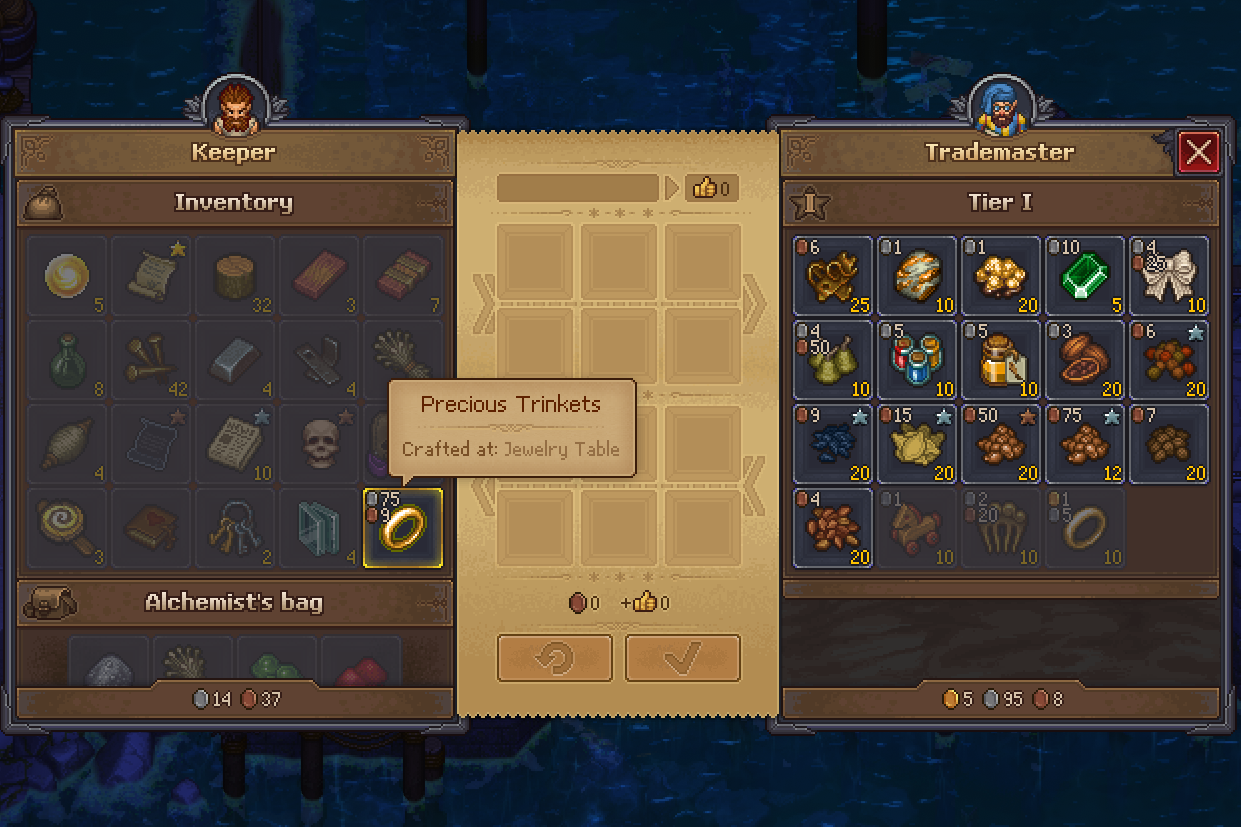
- The Trademaster also sells higher-quality seeds once the player finishes the combat “Break Through to the Port” and trading at the port becomes available. His stock includes Silver-quality cabbage, onion, and pumpkin seeds, as well as different grades of grape seeds.
- Another useful source is Davy the Dagger. His Looters can provide seed crates through his orders. The Small Order provides Silver-quality seeds, while the Medium and Big Orders provide Gold-quality seeds and larger quantities. This is the best place to obtain the first batch of Gold-quality seeds.
- Vegetable Stand in the Town provides Silver- and Gold quality seeds as well, upon upgrades.
- The farm itself eventually becomes another source of seeds. Harvesting crops can return seeds (both same-quality seeds and higher-quality seeds) alongside the harvested produce, allowing the player to gradually build up a self-sustaining supply and increase the crops’ quality.
This makes seed progression an important part of farming. Rather than continually buying low-quality seeds, the player should work toward maintaining and producing higher-quality seeds as the farm develops.
Explore: Graveyard Keeper 2 Make Money: 3 Major Methods Compared
Crop Info Panel & Success Rate: Farming Mastery vs. Garden Bed Mastery
Graveyard Keeper 2 has a rather complicated farming success rate system. It consists of two major parts: the player’s Farming Mastery level when sowing the seeds, and the Garden Bed Mastery level when the crops are growing. Both parts decide eventually how many successful Growth Ticks the player can get. But first, what is the Growth Tick?
Growth Tick is:
- The longest bar at the crop info panel that the player may have seen turn both red and green as the crop grows.
- It corresponds to the number of yields that the player can harvest.
- It also corresponds to the number and the quality of seeds that the player can get from the harvest.
- The percentage at the lower left corner is the percentage chance of whether the next Growth Tick will turn green or red.
Sowing the Seeds: The Player’s Farming Mastery Level
The player’s Farming Mastery level decides whether the player can sow the seeds at all and the success of the first couple of Growth Ticks. There are several situations that can happen:
- The player’s Farming Mastery level is way below the requirement, for example, trying to sow seeds requiring level 10 when the player is at level 3: The game will not allow the player to plant at all.
- The player’s Farming Mastery level is close to the requirement, for example, trying to sow seeds requiring level 10 when the player is at level 7: The player can sow the seeds with a failure percentage. The player can notice that sometimes they will fail 1 – 3 blocks of progress. Then the Growth Ticks of the crop will have several failed (red) ones upon completing the sowing.
- The player’s Farming Mastery level is above the requirement, for example, trying to sow seeds requiring level 10 when the player is at level 12. The player will succeed in all 4 blocks of progress, and there will not be failed Growth Ticks upon completing the sowing.
The player can increase Farming Mastery through:
- Better farming tools
- Farming perks
- Other Mastery bonuses from dishes

Crops Growing Stage: Garden Bed’s Farming Mastery Level
The Garden Bed’s Farming Mastery level decides the success rate of each Growth Tick. There are two situations that can happen:
- The Garden Bed’s Farming Mastery level is below the requirement; for example, the crop requires level 10 when the Garden Bed is at level 3: The game will show a percentage chance of whether the next Growth Tick will turn green or red in the lower left corner of the crop info panel.
- The Garden Bed’s Farming Mastery level is above the requirement, for example, the crop requires level 10 when the Garden Bed is at level 10 or above. Every Growth Tick will turn green and succeed.
The player can increase the Garden Bed’s Farming Mastery through:
- Garden Upgrades
- Peats, Farming Fertilizer I, II, and III

Explore: Graveyard Keeper 2 How to Make Zombies: Resurrection, Materials & Process All Explained
Fertilizers: Add Bonuses to the Garden Beds
Fertilizers provide another way to improve the farm. Each type has a different purpose, so the player should choose the fertilizer according to whether the goal is improving growth success, starting crops with additional successful progress, or developing better seeds.
The most used fertilizers are usually the Farming Fertilizers and Crop Boosting Fertilizers. The first one can help narrow the gap between the player’s Farming Mastery level and the crop’s required Mastery level. The second one can help the player gradually level up the quality of the crops.
There is also an important point about the 100% success rate. Once the Garden Bed already has enough skill for the crop to succeed consistently, adding further Farming Fertilizer will not create an unlimited increase in the harvest. The goal is to reach the necessary skill threshold rather than simply applying as much fertilizer as possible.
Fertilizer Types Comparison
| Fertilizer | Main Effect | Best Use |
|---|---|---|
| Farming Fertilizer I | Increases the Garden Bed’s Farming Mastery level by 2 | Improves Growth Tick success rate and helps the Garden Bed to reach the crop’s required Mastery level. |
| Farming Fertilizer II | Increases the Garden Bed’s Farming Mastery level by 3 | Improves Growth Tick success rate and helps the Garden Bed to reach the crop’s required Mastery level. |
| Farming Fertilizer III | Increases the Garden Bed’s Farming Mastery level by 5 | Improves Growth Tick success rate and helps the Garden Bed to reach the crop’s required Mastery level. |
| Headstart Fertilizer I | Adds 1 successful Growth Tick at the beginning | Increases successful Growth Ticks |
| Headstart Fertilizer II | Adds 2 successful Growth Ticks at the beginning | Increases successful Growth Ticks |
| Crop Boosting Fertilizer I | Adds 1 more higher-quality seed to the bar | Helps produce more higher-quality seeds |


Explore: Travellers Rest Yeast: All Yeast Types and Where to Get Them
Seed Quality and Crop Quality Explained
- Seed quality decides the crop quality. For example, crops grown from Gold-quality seeds will be Gold quality.
- The crops’ quality corresponds to the food and drink quality. For example, if the Mercenary side quest requires Gold-quality wine, the player needs to produce Gold-quality grapes first. There is no other improvements that can be made to compensate for grapes that have not reached the required quality.
Therefore, a player working toward Gold-quality products should focus on obtaining more high-quality seeds.
Explore: Fields of Mistria Greenhouse: Best Setup and Farming Income
Important Crops in Graveyard Keeper 2
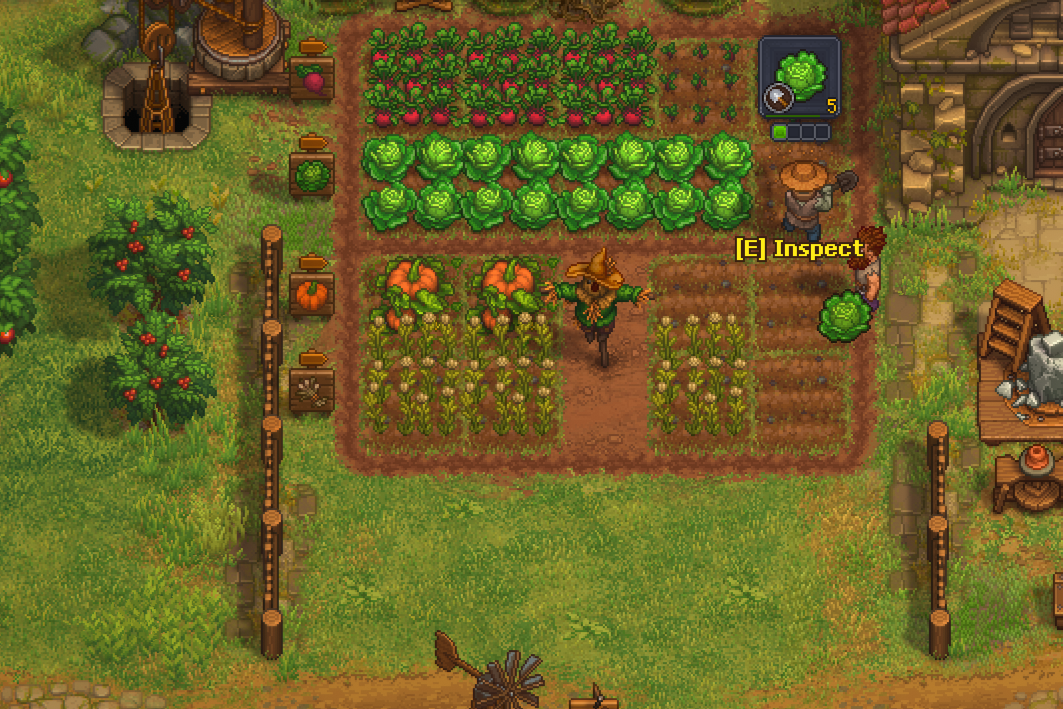
During the early and mid game, Wheat and Flax should occupy a substantial portion of the garden. A practical setup is to dedicate roughly 50% of the gardening area to Wheat and Flax, while using the remaining 50% for a mixture of vegetables.
- Wheat has particularly low Farming requirements and is useful in unlocking several early game recipes and maintaining Stamina.
- Flax is similarly valuable more towards the mid-game phase, because it feeds into crafting and Town Order systems. For example, the player can trade Fabric Supplies for Town Gratitude.
- The other half of the garden can be used for a mixture of vegetables. Maintaining several crops gives the player a flexible supply of ingredients for cooking, Mastery level bonuses, and, later, fulfills the Vegetable Supplies as well.
Explore: Is Graveyard Keeper 2 Worth It? Core Gameplay, 6 Key Sectors, Automation & Combat
Zombie Automation
Once the player has obtained zombies and unlocked Zombie Gardening, the garden can be automated with Gardener Stands.
A basic setup is:
- Build a Gardener Stand.
- Put a zombie to the stand.
- Give the zombie a Shovel.
- Prepare the Garden Beds.
- Build a Chest in the garden.
- Put the required seeds into the Chest.
- Assign rows or columns of beds to the crops that should be grown at the Garden Blueprint.
Once set up, each assigned area can be dedicated to a particular crop, while the zombie takes the required seeds from the garden chests and returns harvested crops, seeds, and leaves to the chest.
One thing worth mentioning is the Lifting Crane. This part is related to the underground automation factory, where the player can assign zombies to make Vegetable Supplies. The gardening zombie can store the crops in the Crane, and the Crane will lift the supplies directly to the underground factory.
Zombies with low-level Farming Mastery seem to be able to grow high Farming Mastery level crops regardless. This could also be a bug.

Explore: Graveyard Keeper 2 Beginners Guide: 7 Ways to Get a Head Start in the Early Game
Graveyard Keeper 2 Farming Efficiency
Graveyard Keeper 2 farming is one of the best systems to combine with zombie automation in early game. Simple Gardener Stands, crop tablets, Shovels, and garden storage allow zombies to handle the repetitive work while the player focuses on quests, crafting, exploration, and other progression.
The result is a farming system that develops in stages: obtain better seeds, improve Farming Mastery, upgrade the Garden, strengthen Garden Bed Mastery levels with fertilizers, and eventually hand the repetitive work over to zombies. Understanding these separate systems makes it much easier to turn the small starting Garden into a reliable source of crops and production materials throughout the game.
💀 If you are confused about how to navigate through alchemy, autopsy, automation, this and that…., our Graveyard Keeper 2 Guide Hub is your home for graveyard management tips, farming guides, crafting tutorials, zombie automation, alchemy, cooking, and much more. We add new guides regularly, so be sure to check back as the graveyard continues to grow!

Graveyard Keeper 2 Farming Guide: From Gardening Basics to Automation
Graveyard Keeper 2’s farming involves seed quality, mastery levels, and zombie automation for efficiency….

Graveyard Keeper 2 Make Money: 3 Major Methods Compared
Find out which of these three main money-making methods in Graveyard Keeper 2 matching your current stage the most: Burial…

Graveyard Keeper 2 How to Make Zombies: Resurrection, Materials & Process All Explained
The guide explains how to create and improve zombies in Graveyard Keeper 2’s Resurrection Lab….

Graveyard Keeper 2 Beginners Guide: 7 Ways to Get a Head Start in the Early Game
All the priority recommendations for Graveyard Keeper 2 beginners!…

Is Graveyard Keeper 2 Worth It? Core Gameplay, 6 Key Sectors, Automation & Combat
Graveyard Keeper 2 offers engaging management gameplay with a focus on automation, zombies, and crafting. (Take some brain to be…